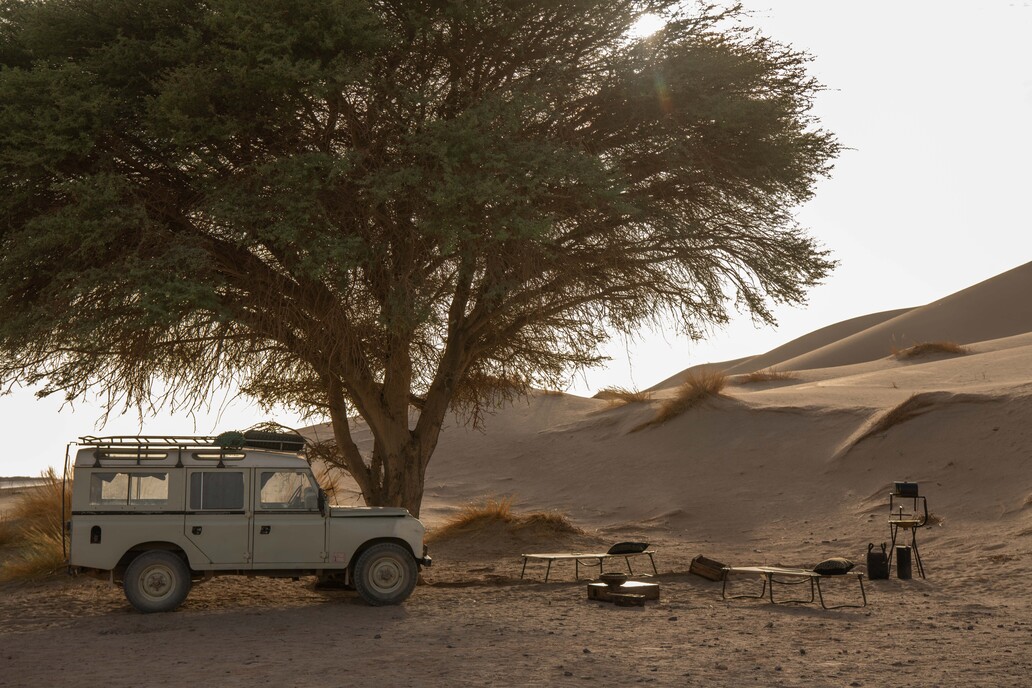
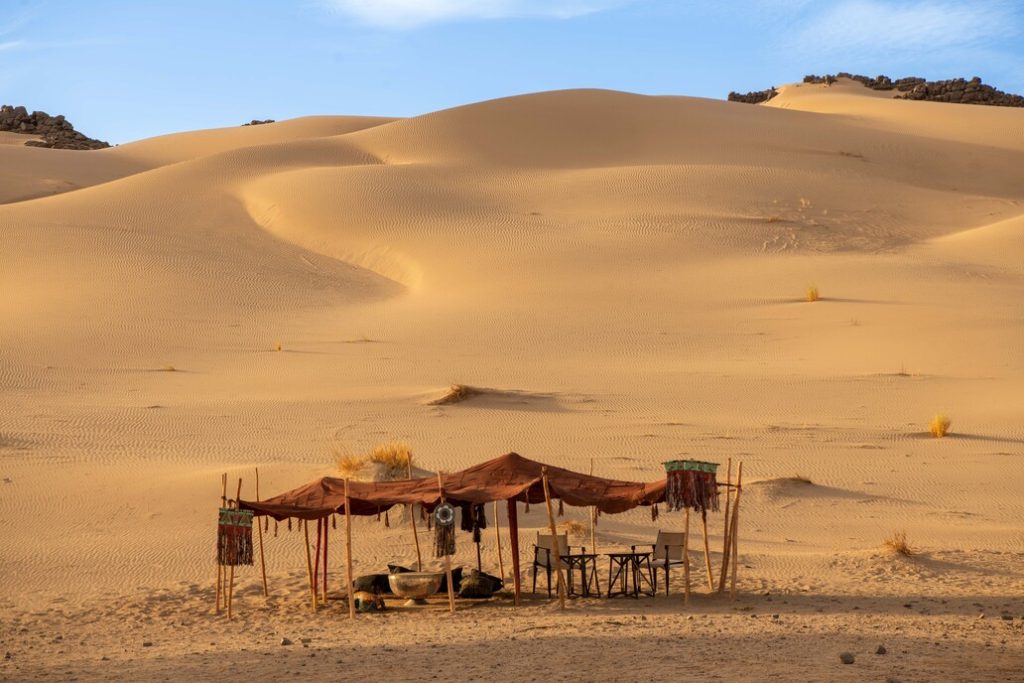
I’ve worked in hospitality my whole life, and I thought I had seen and experienced everything Morocco had to offer. But Tiskmoudine made me fall in love with my country again. It reminded me of the countless small and extraordinary Amazigh communities whose resilience and creativity have woven the rich tapestry of Morocco’s history and which lie well off the beaten path in some of the most challenging and startlingly beautiful landscapes in the world.
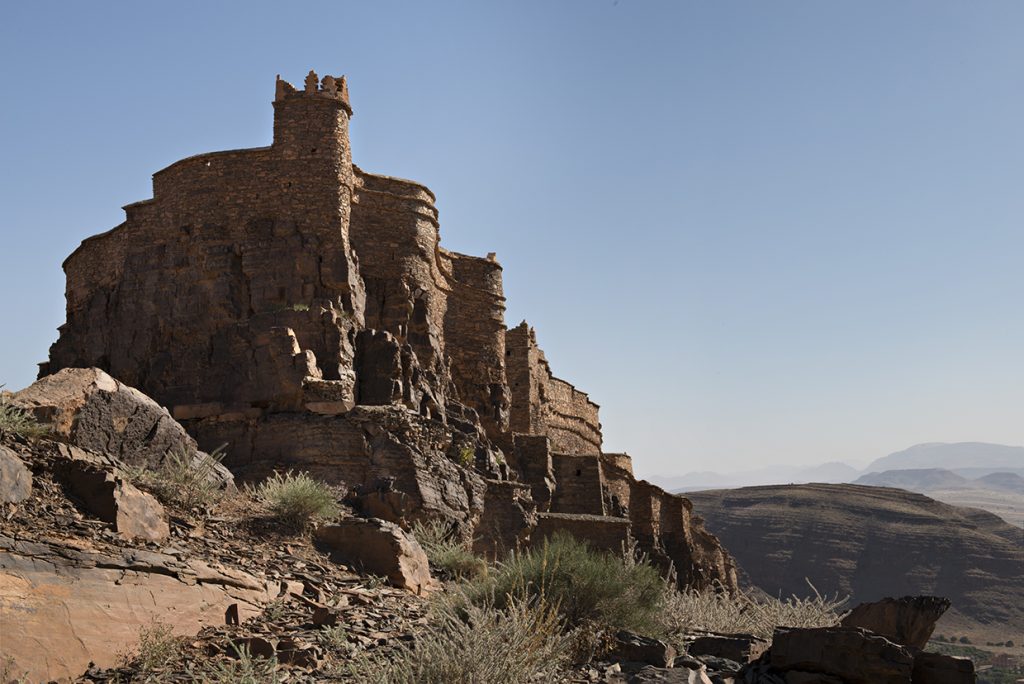
The earthen village of Tiskmoudine is at least 600 years old. It is a unique oasis agadir; a sacred granary within a fortified citadel designed to safeguard a desert community and their scarce resources. Abandoned only 50 years ago, now its shadowy walkways are eerily quiet, and its honeycomb of houses slowly disintegrating back into the earth. I hiked through the ruined streets to the mosque at its heart, which remains magically intact and is lit atmospherically by a single shaft of light. Around the mihrab (prayer niche) organic, pre-Islamic patterns are still vibrantly coloured and I thought of the reverent hands that painted them a millennium ago as well as the countless heads that have touched the caramel-coloured sand in prayer, hoping perhaps for a plentiful harvest, good health or the birth of a boy or girl. It was a truly emotional experience standing in that hallowed place and I felt overwhelmed by a visceral connection to our ancient past.
The journey to Tiskmoudine, part of our Memory Quest trip, is more than just a holiday or an adventure trip. It is an experience that will transport you in a way that only the best travel experiences do. This is what we strive for at Inclusive Morocco, not luxury travel focused on spectacle and expensive suites that leave both traveller and host feeling a little empty and wondering what it was all about. We believe a deeply rooted local perspective – including the villagers in Tiskmoudine – is vital to achieving authentic, immersive cultural experiences.
As one of the only Moroccan-led luxury travel companies, we focus on centering locals in all our experiences. The Amazigh community – who continue to inhabit this ancient cultural heritage – are the true hosts of the Memory Quest’s pioneering micro-hospitality ventures where visitors are accommodated in village houses restored by architect-anthropologist Salima Naji with support from the Global Heritage Foundation. Who better to explain the extraordinary life lived in Tiskmoudine and how the agadir functioned as an ancient bank, community exchequer and communal node in a wider tribal network of igoudar (granaries)?
We experience the transformative power of these encounters ourselves when we test run our trips. In Tiskmoudine we spent time with the Amazigh maalmates (weavers) of the local craft co-operative who safeguard the craft of weaving camel hair, talefdamt (palm husk) and wool into unique, three-dimensional tapestries. These objects inspired Amina Agueznay – one of Morocco’s foremost female artists – to create the Portals series that won the Norval Sovereign African art prize in 2024 and will be exhibited at Morocco’s first national pavilion at the 2026 Venice Biennale.
These woven artworks are the ancient cultural heritage of Tiskmoudine, but they are only just being recognised on the global stage thanks Agueznay’s international profile. This prompted us to design a new Art versus Craft tour (more about that soon), which examines the tension/boundary between the two fields and transports travellers from Morocco’s craft capital Fes to the fashionable galleries of Marrakech via some of the most beautiful landscapes in the High Atlas mountains where we visit a wool supply company using a revolutionary solar power mill that is spinning Africa’s first carbon-negative yarns and reinvesting proceeds into regenerative land practices.
This is what the word inclusive means in our name. The involvement of Moroccans from all walks of life and corners of the country: the rural traditionalists of Tiskmoudine who safeguard an arcane Amazigh community; a practising member of the faith community giving a tour of the Hassan II mosque in Casablanca; a passionate feminist speaking about the work of groundbreaking author Fatima Mernissi while you explore Fes; or a liberal urbanite giving you a tour of Rabat’s street art during the Jidar Street Art Festival. All these perspectives show visitors different authentic faces of multifaceted Morocco.
Back in Tiskmoudine we spent our night in one of Naji’s three reconstructed village homes. There is no electricity, so the whole village is magically lit by flickering lanterns, and dinner is served in a theatrical, candlelit corner of the beehive village. The rooms, too, are free of frills but comfortably furnished with wood-fired stoves and beds dressed in textiles loomed right here. It feels like spending the night in a World Heritage site, which one day it might be as Morocco are campaigning to have igoudars like this recognised by UNESCO.
The rest of the Memory Quest unfolds in similarly unique environments – the almost inaccessible Red House in the geological wonder of the Awju Valley, a small mud-brick cottage in Assa, a true oasis shaded by palms and irrigated by ancient earthen canals, and a final a rocky eyrie overlooking a valley of ancient Argan trees where three shepherd families remain. Each location grants you privileged access to a community, and each encounter guarantees a meaningful connection that redefines luxury through relaxed simplicity and purpose while helping to preserve the delicate ecosystem of oasis life, safeguarding the cultural heritage of villages like Tiskmoudine and supporting local economies in often overlooked places.
It’s in these shared experiences, where guest and host are eye-to-eye, that we find the true magic of Morocco, and the most meaningful travel moments. Because this is a place where the people you meet become as much a part of your story as the places you visit. Our promise is to deliver those transformative journeys and show you aspects of the country and culture that will surprise and delight. Memories of Tiskmoudine live brightly in my mind’s eye and I look forward to conjuring memories like that for guests of Inclusive Morocco. I hope to see you on the journey soon.